Solar DC sizing — NEC 690.8
Enter module Isc and the app applies the 1.56× correction automatically (1.25 short-circuit × 1.25 continuous). No paper math, no missed factors.
NEC 2023 wire sizing for solar installers, electricians, and PV system designers. Built for the rooftop, the truck, and the AHJ inspection.
Built for United States · NEC 2023
No spam. One email when it ships, then nothing.
Enter module Isc and the app applies the 1.56× correction automatically (1.25 short-circuit × 1.25 continuous). No paper math, no missed factors.
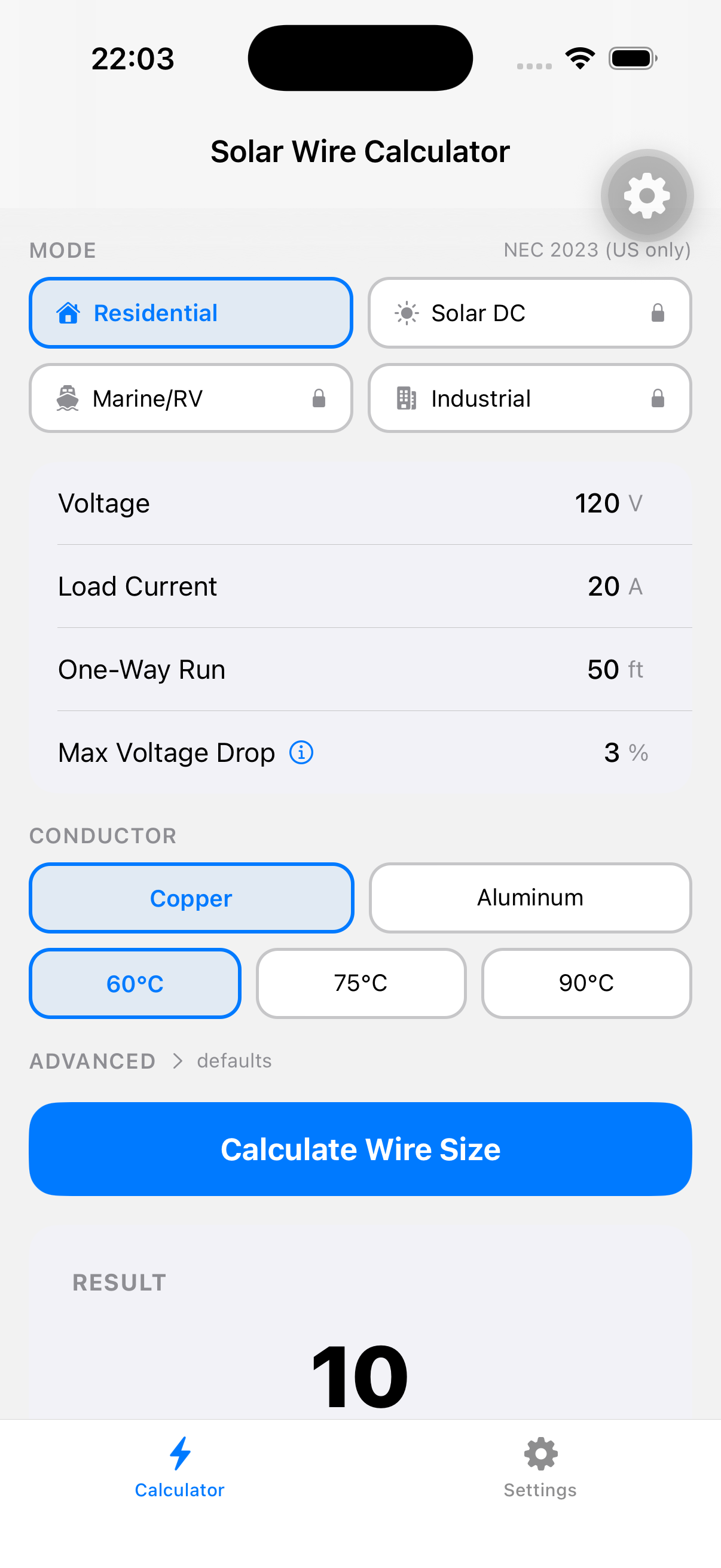
Solar DC, residential AC (120V/240V), marine/RV (ABYC E-11), and three-phase industrial (208V, 277V, 480V). One install covers every job.
NEC 310.15(B) factors built in. Rooftop in Phoenix at 47°C? Adjusted automatically. The wire gets upsized before the inspector finds it.
NEC 310.15(C)(1) — when you pull more than three current-carrying conductors, the app derates the ampacity (0.80 / 0.70 / 0.50) so your run still passes.
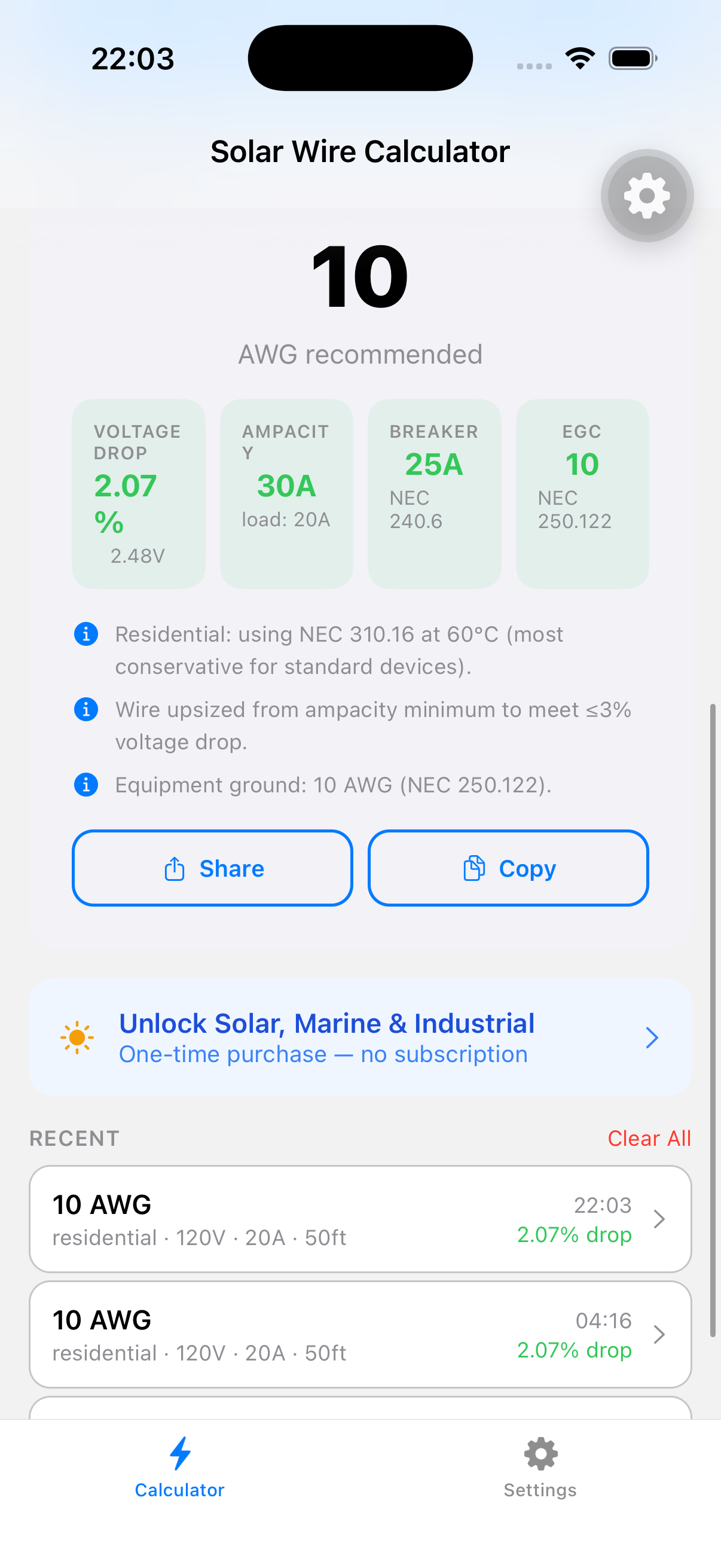
Equipment grounding conductor sized to your overcurrent device — not guessed. Every result tells you which AWG ground to pull.
Works on rooftops, in basements, in metal-clad commercial buildings — anywhere with no signal. Calculations run on-device, never cloud-dependent.
8 min read
A residential rooftop PV install looks simple from the street: panels, micros or string inverter, conduit down the wall, into the main panel. The wire sizing inside that picture is where job sites get tripped up. National Electrical Code 2023 has at least five separate articles that touch a single PV conductor — and missing any one of them is a real failure mode at the inspection, not a paperwork formality.
The five things any solar wire sizing has to get right:
This is why an installer with twenty years of experience still keeps a paper codebook in the truck. None of the pocket apps — and there are dozens — actually cover all five at once for a solar string. Solar Wire Calculator was built specifically to close that gap for US installers working under NEC 2023.
NEC 690.8 is the article that governs PV system circuit sizing. It says that the maximum circuit current for a PV source circuit is the sum of parallel module short-circuit currents (Isc) multiplied by 125%. That accounts for the fact that on a cold, clear, high-irradiance day, a PV module can output more than its nameplate Isc — sometimes considerably more, because Isc rises slightly with irradiance and increases with falling cell temperature.
That gives you 1.25 × Isc.
Then NEC 690.8(B) says that, because PV is treated as a continuous load (current expected to flow for three hours or more), the conductor and overcurrent protection have to be sized for another 125% of the maximum circuit current. Continuous loads always get this 125% adder under NEC.
So you take the original Isc, multiply by 1.25 (the 690.8(A) irradiance correction), then by 1.25 again (the 690.8(B) continuous-load adder):
Conductor sizing current = Isc × 1.25 × 1.25 = Isc × 1.5625
Rounded, that’s 1.56× Isc. A module rated 11.3A Isc gets sized at 17.6A for conductors and breakers — not at 11.3A.
Forgetting the 1.56× factor is the most common mistake on rooftop solar sizing. Solar Wire Calculator applies it automatically the moment you switch to Solar DC mode. You just enter the rated Isc from the module datasheet and the app does the math.
NEC 310.16 ampacity tables are published for an ambient temperature of 30°C (86°F). If you size wire straight off Table 310.16 for a rooftop in Texas, Arizona, Nevada, or California in summer, you’ve already understated the conductor temperature by 15–20°C. Real rooftop ambient in those climates is 40–50°C; on a black asphalt roof in direct sun, the conductor itself can be hotter still.
NEC 310.15(B) is the article that handles this. It gives you correction factors:
| Ambient temperature | 60°C wire | 75°C wire | 90°C wire |
|---|---|---|---|
| 21–25°C | 1.08 | 1.05 | 1.04 |
| 26–30°C | 1.00 | 1.00 | 1.00 |
| 31–35°C | 0.91 | 0.94 | 0.96 |
| 36–40°C | 0.82 | 0.88 | 0.91 |
| 41–45°C | 0.71 | 0.82 | 0.87 |
| 46–50°C | 0.58 | 0.75 | 0.82 |
| 51–55°C | 0.41 | 0.67 | 0.76 |
| 56–60°C | — | 0.58 | 0.71 |
You take your ampacity from Table 310.16, multiply by the correction factor for your ambient, and that’s your real allowed ampacity. Then you check whether your design current still fits.
Solar Wire Calculator does this automatically. You set the ambient temperature once at the top of the Solar DC mode, and every subsequent calculation uses the corrected ampacity. Set it to 47°C for Phoenix, 35°C for San Diego, 30°C for Seattle. The app upsizes your wire before the inspector measures the conduit temperature with an IR gun.
When you pull more than three current-carrying conductors through the same raceway — common on rooftop solar string runs that share a conduit — the ampacity drops further. Heat from neighboring conductors compounds:
This factor stacks on top of the ambient temperature correction. A rooftop solar run with two strings sharing a conduit (4 current-carrying conductors at 47°C ambient on 90°C wire) gets a combined factor of 0.82 × 0.80 = 0.66. That can be enough to push you up a wire size or two from what Table 310.16 looks like at first glance.
Solar Wire Calculator handles this. Tell it how many current-carrying conductors are in the raceway, and the conduit fill factor is applied automatically alongside the ambient correction.
Your EGC is sized from a different table than your phase conductor. NEC 250.122 ties EGC size directly to the upstream overcurrent device:
| Overcurrent device (A) | Copper EGC (AWG) | Aluminum EGC (AWG) |
|---|---|---|
| 15 | 14 | 12 |
| 20 | 12 | 10 |
| 30 / 40 / 60 | 10 | 8 |
| 100 | 8 | 6 |
| 200 | 6 | 4 |
| 300 | 4 | 2 |
| 400 | 3 | 1 |
So if your PV source circuit lands on a 20A breaker, you pull a 12 AWG copper EGC. If it lands on a 60A combiner, you pull 10 AWG copper or 8 AWG aluminum. Solar Wire Calculator picks this for you the moment it knows the breaker size, and shows it on every result card.
Let’s run a real one. A 6 kW rooftop array, 15 modules in a single string, each module:
Run length from the rooftop combiner box to the inverter on the ground floor: 80 feet one-way.
Ambient (Phoenix rooftop, July afternoon): 47°C.
Insulation: 90°C rated PV wire (USE-2 / PV-wire), copper, in conduit from the array down the side of the building.
Two strings sharing the conduit: 4 current-carrying conductors.
Sizing current per NEC 690.8: 10.2A × 1.56 = 15.9A.
Pull up Solar Wire Calculator → Solar DC mode. Enter Isc 10.2, voltage 600V, run length 80 ft, max voltage drop 2%, ambient 47°C, copper, 90°C wire, 4 current-carrying conductors.
Result the app returns:
That’s a one-screen answer that would have taken a paper-codebook installer five minutes to look up across three different tables. And it’s the same answer every time, with the article numbers on the result card to defend at the AHJ inspection.
Most rooftops have lousy cell signal. Most metal-clad commercial buildings have none. Most rural service installs are 30 minutes from the nearest tower. A wire sizing app that quietly fails-over to “no internet” the moment you climb a ladder is a tool you can’t actually use on a job.
Solar Wire Calculator runs 100% on-device. There is no login, no telemetry, no cloud sync, no analytics call. Every NEC table is bundled into the binary. The app works exactly the same in airplane mode. This isn’t a marketing line — it’s what you actually need at the top of the ladder when the inspector is walking the roof in 30 minutes.
Solar Wire Calculator is NEC 2023-only. It does not include CSA C22.1 (Canada), BS 7671 (UK), IEC/HD 60364 (Europe), or AS/NZS 3000 (Australia/New Zealand) tables. Conductor sizing rules differ meaningfully between these codes — different ampacity tables, different derating factors, different grounding philosophies, AWG vs mm² conductor sizing.
The US installer is the persona this app is built for, and being honest about that is more useful than claiming global coverage and being wrong everywhere. If you’re a NABCEP-certified PV installer, a licensed electrician working under NEC 2023, an AHJ inspector verifying somebody else’s design, or a PV system engineer drafting plan sets for permit submission, this app is built for you.
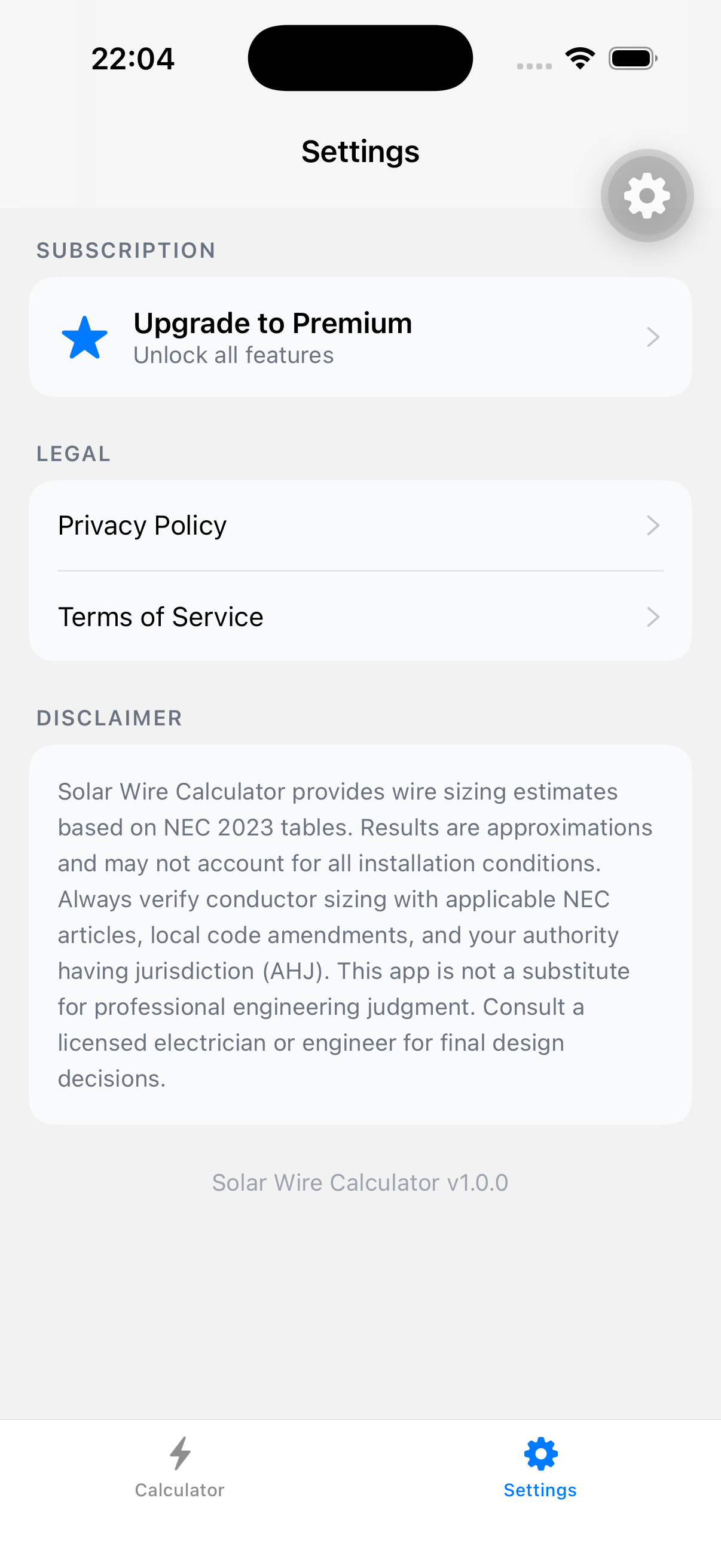
Residential mode (NEC 310.16, single-phase 120V/240V branch and feeder circuits) is free, forever. Tap the “Pro” button to unlock the three other modes — Solar DC, Marine/RV, and Industrial three-phase — for a one-time $4.99 purchase. There is no subscription, no monthly fee, no auto-renew, no ads, and no data collection. You pay once and the modes unlock on every iPhone signed into your Apple ID.
NEC 2023 wire gauge sizing for solar installers, electricians, and PV system designers. Solar DC, residential AC, marine, and industrial — all in one offline-first iOS app.